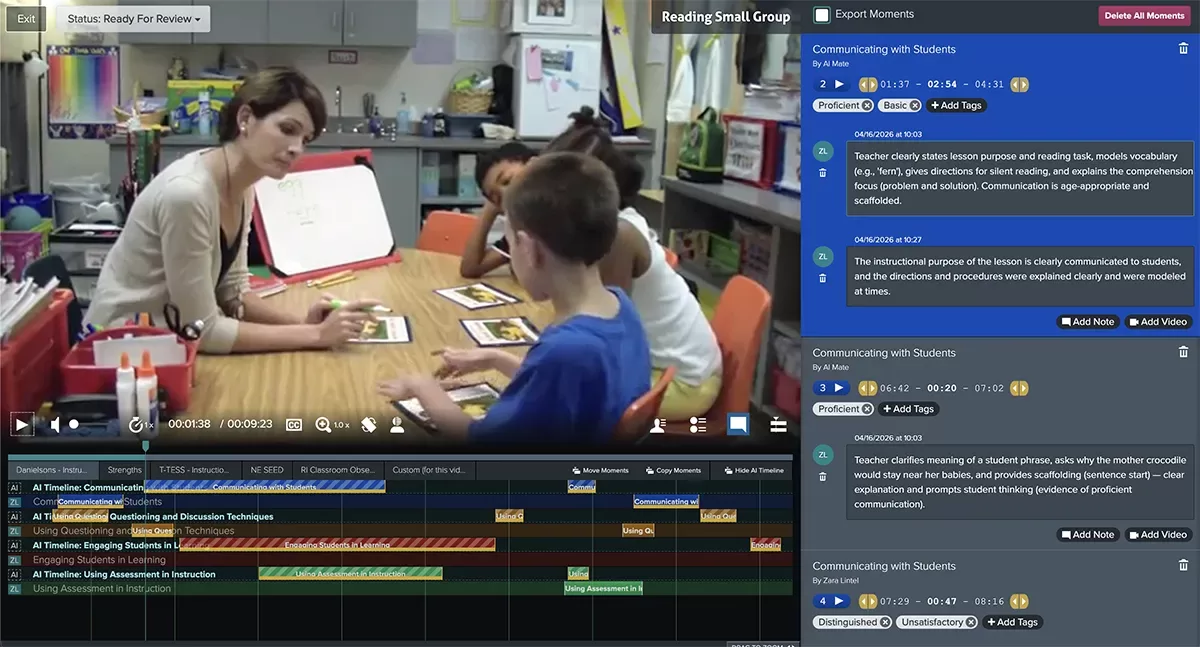
In a recent webinar hosted by the University of Rhode Island (URI) Translanguaging Lab, educators and researchers came together to explore how Vosaic can be used to support rigorous, humanizing qualitative data analysis, particularly in multilingual and multimodal learning contexts.
Led by Dr. Nicole King and Dr. Gene Molini, the session blended theory, classroom examples, and a live walkthrough of Vosaic to demonstrate how video-based research and reflection can be made more systematic, meaningful, and human-centered.
About the URI Translanguaging Lab
Dr. Ortiz explained that the lab is dedicated to researching multilingualism and multilingual learning while centering linguistic justice. Its work spans research, mentoring emerging scholars, professional learning for educators, and the development of shared resources to advance translanguaging scholarship and practice.
Events like this webinar reflect the lab’s commitment to supporting educators and researchers who are working across languages, modalities, and educational contexts.
What Is Vosaic and Why Does It Matter for Qualitative Research?
Dr. King introduced Vosaic as a powerful platform for multilingual, multimodal discourse analysis. Originally used in her own dissertation research, Vosaic enables users to succeed in different areas of their work. From uploading and organizing long-form classroom or instructional videos into structured projects, creating customizable coding forms to mark pedagogical moments in real time, capturing video clips with precise durations, including configurable time before and after each coded moment, and analyzing how language, gesture, gaze, space, and interaction work together in meaning-making.
Importantly, Vosaic supports both research and professional learning, making it useful for qualitative scholars, teacher educators, instructional coaches, and classroom teachers.
Multilingual & Multimodal Discourse Analysis in Action
A key focus of the session was how Vosaic supports multilingual multimodal discourse analysis, an approach that values communication beyond spoken language alone. Dr. King highlighted how researchers can attend to linguistic choices across multiple named languages, gestures, eye gaze, or spatial positioning and contextualization cues and modal density.
Using Vosaic, these complex layers of interaction can be isolated into “telling moments,” allowing researchers to move from large, overwhelming datasets to focused, analytically rich clips.
Humanizing Pedagogy as the Analytical Framework
Dr. Molini expanded this technical demonstration into theory, introducing humanizing pedagogy as the guiding analytical lens. Drawing on the work of Paulo Freire, Lilia Bartolomé, and Maria del Carmen Salazar, she described humanizing pedagogy as an asset-based, student-centered approach that values students’ languages, cultures, and lived experiences, treats prior knowledge as a foundation for learning and recognizes teaching as a political, non-neutral act.
They discussed key principles from translanguaging, relevant content, pedagogical language knowledge to trusting relationships, critical consciousness, and student empowerment.
Classroom Case Study: From Full Lesson to Meaningful Moments
To bring theory and tool together, the presenters shared a case study from a bilingual French–English second-grade classroom. Using Vosaic, they analyzed an hour-and-a-half instructional event by breaking the lesson into manageable video segments, coding moments aligned to humanizing pedagogy and automatically generating short clips tied to each code.
The result was a clear visual and analytical map of how often humanizing practices appeared throughout the lesson. Clips illustrated how a single activity could simultaneously foster translanguaging, build trusting relationships, and develop students’ critical consciousness.
Transcription, AI, and Deeper Analysis
The webinar also highlighted Vosaic’s automated transcription capabilities, including multilingual transcription that can switch between languages, speaker identification and editable transcripts and a foundation for deeper discourse and interaction analysis.
An overview of Vosaic’s AI-powered analysis features showed how users can ask qualitative or quantitative questions of their video data, such as identifying when specific languages are used or how often certain instructional moves occur, while grounding insights in research-based references.
Beyond Research: Reflection, Coaching, and Professional Learning
While Vosaic is a robust research tool, presenters emphasized its value for teacher self-reflection, instructional coaching and supervision and collaborative PLC conversations.
By coding and discussing video clips together, educators can engage in dialogic, evidence-based reflection around pedagogical goals such as humanizing, cultural sustaining, or trauma-informed teaching.
Ready to Explore Vosaic?
Whether you’re conducting qualitative research, coaching educators, or reflecting on your own teaching practice, Vosaic can help you turn complex video data into meaningful insights. Sign up for a free trial of Vosaic or submit a contact us form for more information!
We’d love to help you see how Vosaic can support your research, teaching, and professional learning goals.