How Instructional Coaches Can Lead AI Adoption in Schools Without Adding to Teachers' Plates
Every school district is feeling the pressure of AI. Leadership is asking what the plan is and teachers are already stretched thin. The last thing anyone wants is another initiative landing on their already full desks.
Before AI even entered the picture, most teachers were already skeptical of their professional development programs. A Pew Research Center survey from 2024 found that only 36% of teachers were satisfied with their opportunities for training and developing new skills, which was one of the lowest satisfaction scores across every aspect of the job Pew measured. Now add AI into the picture. Not only is a new tool being introduced, but it's an introduction to a new tool for teachers who already feel like they don't get the full support they need to grow.
This is where instructional coaches come in. They can use their credibility for hard conversations and see how engaged each teacher is within a session to accurately adjust and tailor individual programs.
Teachers are intimidated and skeptical of AI because they're handed out a tool they're supposed to figure out on their own time without context or a clear reason why it's supposed to support them. This is a reasonable fear, but it's also a solvable one instructional coaches can help with.
AI Adoption in Schools Isn't a Technology Problem
Finding AI tools is the easy part. Getting teachers to trust the rollout is where most efforts stall.
According to The 74, the number of districts offering teacher AI professional development jumped from 63% to 86% in a single year. Speed isn’t the same as strategy. Most districts are still in testing mode and handing teachers apps, hoping adoption will follow, but it rarely does.
Teachers consistently face increased workload during the initial phase of AI adoption as they adapt lesson plans and familiarize themselves with new systems. In other words, the rollout itself typically adds to the burnout it was supposed to lessen. This influences how teachers will only adopt tools they see as time-savers and push back on tools that feel like additional work without a clear payoff.
This is a change-management problem, and it's what instructional coaches already know how to do. However, only 50% of teachers had received any AI training by fall 2025, which means for many, the coaching relationship will be their first real, honest exposure to what these tools can do. That's a significant amount of influence and responsibility.
The Three Mistakes Schools Make When Rolling Out AI
It helps to know what doesn't work before mapping what does. Most stalled AI rollouts share one of three patterns.
Mistake 1: Launching tools without a "why" teachers can feel.
When AI is brought as a directive from administration, teachers tend to disengage, not because they’re resisting growth, but because they’re seeing a pattern of a new platform, training, and expectations.
Instead, start with a problem teachers already name out loud. For example, not enough time to give meaningful feedback or lack of data to know if the strategy they tried last month is working. When AI shows up as an answer to a real, felt problem, adoption stops feeling like an ask.
Mistake 2: Treating AI as a standalone initiative.
An AI rollout with its own training block, its own dashboard, and its own separate plan reads to teachers as extra work, because that's usually what it turns out to be.
The districts that succeed in AI adoption don't deploy a tool and declare victory. Buffalo Public Schools restructured its Instructional Technology Coaches to serve as instructional design partners by folding AI into a coaching model. Denver Public Schools distributed ownership across principals, curriculum specialists, and department directors rather than routing everything through a central IT function.
The pattern across these districts is that AI was added to something teachers already did, not replacing it or adding more to it. For practical applications, map your AI tools directly onto your existing coaching framework. If it doesn't fit the existing structure, it won't survive the first semester.
Mistake 3: Leaving teachers to experiment in isolation.
Teachers who are experimenting with AI on their own tend to repeat the same mistakes, miss opportunities from each other, and burn out without recognition. Early adopters carry the weight while hesitant teachers fall further behind.
The fix isn't a training program, but a lightweight sharing structure. Reserving even five minutes to share at a monthly staff meeting of what you tried and what happened does more to move adoption forward than a 90-minute professional development session from a vendor. When teachers hear from peers rather than presenters, the message lands differently.
What Coach-Led AI Adoption Looks Like
Coaches don't need to become AI experts. Instead, they need to maintain curiosity, create beginner-level entry points, and connect tools they introduce to goals teachers already have. Below are some ways to see it in practice.
Start with yourself
Before asking anyone else to try something, try it yourself. Record one of your own coaching session. Run the transcript through an AI tool. Notice what it surfaced, what it missed, and what it got wrong. Then share that honestly with your teachers.
That kind of honest first pass does more to lower anxiety than any all-staff email. Teachers watch what leaders actually do, not what leaders send in a memo.
Anchor every AI tool to a goal the teacher already has
The fastest way to kill AI adoption is to introduce it as "a new thing to try." If you wish to accelerate it, then introduce it as a way to get better data on something a teacher already cares about.
A teacher working on wait time gets talk-time ratios and question patterns they'd never be able to catch while actively teaching, the kind of data that used to require a second adult in the room with a clipboard. A teacher trying to grow student discussion gets timestamps for every stretch a student spoke for more than ten seconds. A vague goal becomes visible and measurable.
Use video as the bridge
Video-based reflection is already how strong coaching programs work, which makes it the natural place for AI to enter the picture.
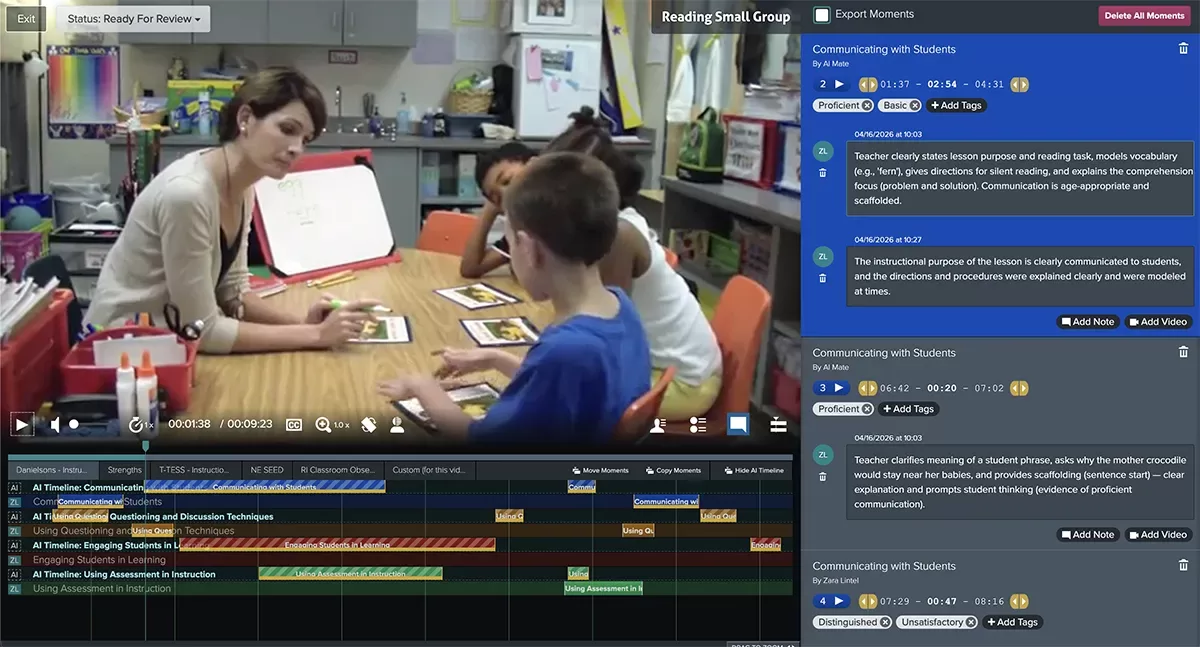
AI-enabled tools can guide teachers through self-reflection and goal-setting, which is a key component of any coaching cycle while also removing some of the administrative workload. What used to take a coach two hours of note-reviewing can now be accomplished in twenty minutes, with better data.
Video makes this reflective, not evaluative. When teachers control the recording, choose what to submit, and review AI-generated insights, the process feels like growth rather than surveillance. Platforms that let teachers review feedback on their own schedule consistently produce more genuine reflection than those that feel evaluative.
This is exactly the workflow Vosaic is built for. The AI Mate is multi-modal. It doesn’t just analyze video transcripts, but it also sees what is happening in the video. It identifies teacher and student talk and surfaces timestamped insights coaches and teachers can explore together without replacing the relationship that makes it meaningful.
Protect teacher time
A district that implemented AI coaching as an asynchronous complement to its existing PD structure found that teachers engaged willingly because it felt like support, because there was no additional workload, which led to higher sustained adoption rates.
When evaluating any AI tool for your coaching program, think about what existing steps it replaces. If the answer is "nothing, because it's an addition to what we already do," the adoption will stall.
Build peer sharing, not a training program
Peer learning structures that create space for early adopters to share openly are the most durable adoption models. Word of mouth from a trusted colleague does more to move adoption forward than any sessions from a vendor. When teachers hear from a peer say, "this actually saved me time and showed me something I hadn't noticed," that carries more weight than any data point you can put on a slide.
The Coach's Role is Evolving, Not Disappearing
The most common concern we hear from coaches is whether teachers will start using AI instead of coming to them. In practice, we tend to see the opposite.
Where should AI be in relation to coaching, then? It should be placed to pull data it can surface that a human simply can't while also observing in the room. Tracking talk-time ratios, question patterns, pacing, and wait time manually while also watching a teacher simultaneously is quite impossible. AI handles that layer well, but what it doesn't know how to do is set the data aside and know when a conversation should start with acknowledgment, not analysis. This aspect still belongs to the human observer in the room.
AI can help extend the reach of coaching by aligning feedback with district improvement plans, teacher goals, and student data. Coaches who walk into post-observation conversations holding AI-generated insights spend less time scripting what to say and more time genuinely co-reflecting. The quality of the conversation goes up and so does the frequency, because each conversation takes less preparation time.
As Teaching Lab CEO Sarah Johnson put it in a recent EdWeek interview:
"Our hypothesis is if you could increase the number of coaching touch points with the teacher, then maybe we can make coaching more efficient and more scalable, and you could extend the reach of a human coach."
This is the right frame, because when coaches spend less time writing observations and more time in actual conversations, they can show up more often and more meaningfully. AI doesn't replace any of that. Instead, it clears enough of the administrative weight that the relationship finally has room to breathe.
The Question Worth Sitting With
Schools are going to adopt AI. That's no longer really a question. The question is whether teachers experience it as one more thing piled on by people who don't spend their days in classrooms or as something that finally gives them a little of their time and clarity back.
That difference comes down almost entirely to how AI gets introduced, and by whom. In most schools, the people teachers already trust to introduce anything hard are the instructional coaches and building leaders sitting closest to the classroom.
——————————————————
Want to see what this looks like inside a coaching platform built for video and evidence-based feedback? Start a free Vosaic trial
Curious how other coaches are using video and AI together? Explore our coaching resources or book a demo to see Vosaic in action.